Walk through any Oktoberfest tent and you’ll see hundreds of dirndls, each with a bow tied at the waist. That bow isn’t just decoration. In Bavaria, where a woman ties the ribbon of her dirndl apron is said to tell everyone around her whether she is single, taken or not looking at all.
Here’s what each position means, how to tie your bow properly, and how much of the custom is real tradition.
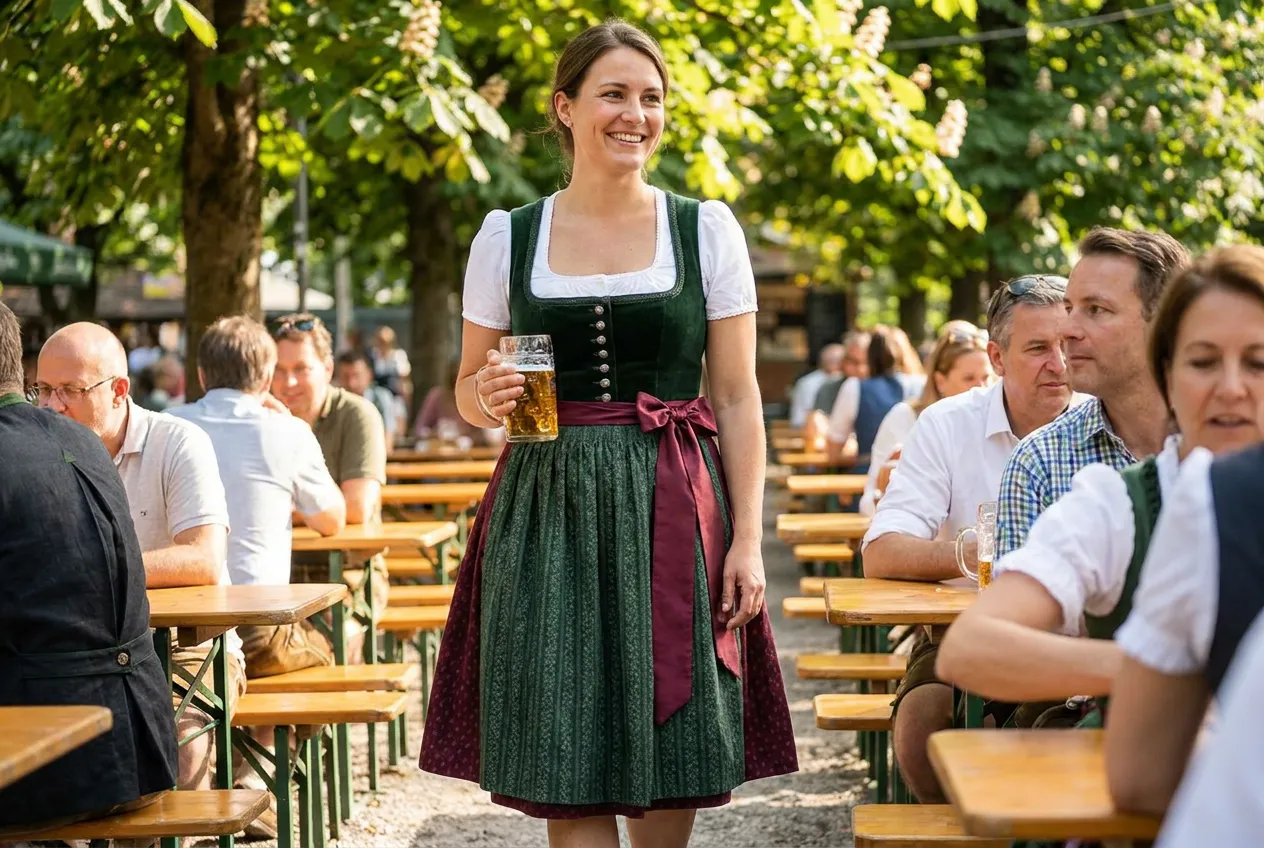
The dirndl bow code at a glance
| Where the bow is tied | What it means |
|---|---|
| On her left | Single, and happy to be asked to dance |
| On her right | Married, engaged or in a relationship |
| At the front centre | A young girl, or traditionally a virgin |
| At the back | Widowed, or working as a waitress |
Left and right are always from the wearer’s point of view. If you’re facing her, a bow on your right is on her left, so she’s single.
Bow on the left: single
A bow tied on the left hip is the one most visitors want to know about. It signals that the wearer is unattached and open to a chat, a dance or a shared pretzel. A popular way to remember it: the heart is on the left, and so is the bow of someone whose heart is still free.
Bow on the right: taken
A bow on the right hip means the wearer is married, engaged or in a relationship. In a busy beer tent, it’s a polite way of saying “thanks, but no thanks” before anyone has to ask.
Bow at the front: a young girl
A bow tied in the middle at the front is traditionally worn by young girls and, in the old telling, by unmarried women who were still virgins. Today it’s mostly seen on children. Some adults choose the centre simply because they’d rather not say either way.
Bow at the back: widowed or a waitress
A bow tied at the back has two meanings. Traditionally it was worn by widows. But the women you’ll see most often with a bow at the back are the waitresses, the Bedienungen who carry ten or more litre steins at a time. For them it’s practical: a bow at the back can’t catch on tables or steins. Read more about them in our article on the German beer girl.
How to tie a dirndl bow
- Put the apron on last, over the dress and blouse, with the top of the apron at your natural waist.
- Take both ribbons around your back, cross them over and bring them forward again.
- Choose your side (left, right, front or back) and pull the ribbons firm, but not tight.
- Tie a simple bow, just like tying a shoelace, a little in front of your hip bone rather than right on the side seam.
- Even it out. The two loops should be the same size, and the loose ends should hang to about the same length.
If the ribbons are very long, wrap them around your waist twice before tying. The apron should finish at the same length as the skirt or slightly shorter.
Watch out for costume dirndls
Many cheap costume dirndls sold for Oktoberfest parties come with the bow already sewn on at the front centre, or a lace-up bodice that looks like a bow. That’s fine for a fancy-dress party, but if you want the bow to say something, choose a dirndl with a separate apron and ribbons you tie yourself. Our list of 15 Oktoberfest outfit ideas includes the Australian stores that sell authentic dirndls with proper aprons.
Is the dirndl bow code a real tradition?
Partly. The dirndl started out as the everyday working dress of rural women and maids in Bavaria and Austria. It became fashionable with city people in the late 19th century and has been the classic festival dress ever since.
Historians of traditional costume point out that there’s little evidence of a strict bow code from those early days. Most of what’s said today grew up in the 20th century and has been spread enthusiastically by dirndl makers, tour guides and the festival itself. Plenty of Bavarian women simply tie their bow on whichever side they like.
That said, the code is now so well known that people in Munich, and at German clubs in Australia, really do read it. So whether or not your great-grandmother followed it, assume someone in the tent will notice which side you’ve chosen.
Ready to put it into practice?
Once your bow is on the right side (or the left), find a tent to wear it in. Our guide to Oktoberfest 2026 in Australia lists every event in Sydney, Melbourne, Brisbane, Perth and Adelaide.
Dirndl bow FAQs
What does a bow on the left of a dirndl mean?
A bow tied on the wearer’s left means she is single.
What does a bow on the right of a dirndl mean?
A bow tied on the wearer’s right means she is married, engaged or in a relationship.
What does a dirndl bow in the middle mean?
A bow at the front centre is traditionally worn by young girls, and once signalled that a woman was a virgin. Some adults wear it to stay neutral.
Why do Oktoberfest waitresses tie their bow at the back?
It keeps the bow out of the way while they carry steins through crowded tents. A bow at the back is also traditionally worn by widows.
Is it left or right from my point of view?
From yours, the wearer’s. A bow on your left hip means single, whatever side it looks like to someone facing you.
Do men have a similar code?
No. Lederhosen and men’s Tracht have no equivalent signal.