The image is known around the world: a smiling woman in a dirndl, carrying an impossible number of foaming litre steins through a packed beer tent. The German beer girl has become as much a symbol of Oktoberfest as pretzels, brass bands and Bavarian lager.
But behind the postcard picture is a real and seriously demanding job. In Germany these women are called Kellnerin (waitress) or, in Bavarian dialect, Bedienung. They are highly skilled professionals who serve thousands of litres of beer over a single festival, often working 12-hour days without a break.
Here are ten things you might not know about the German beer girl, plus some tips if you want to bring the look to your next Oktoberfest party in Australia.
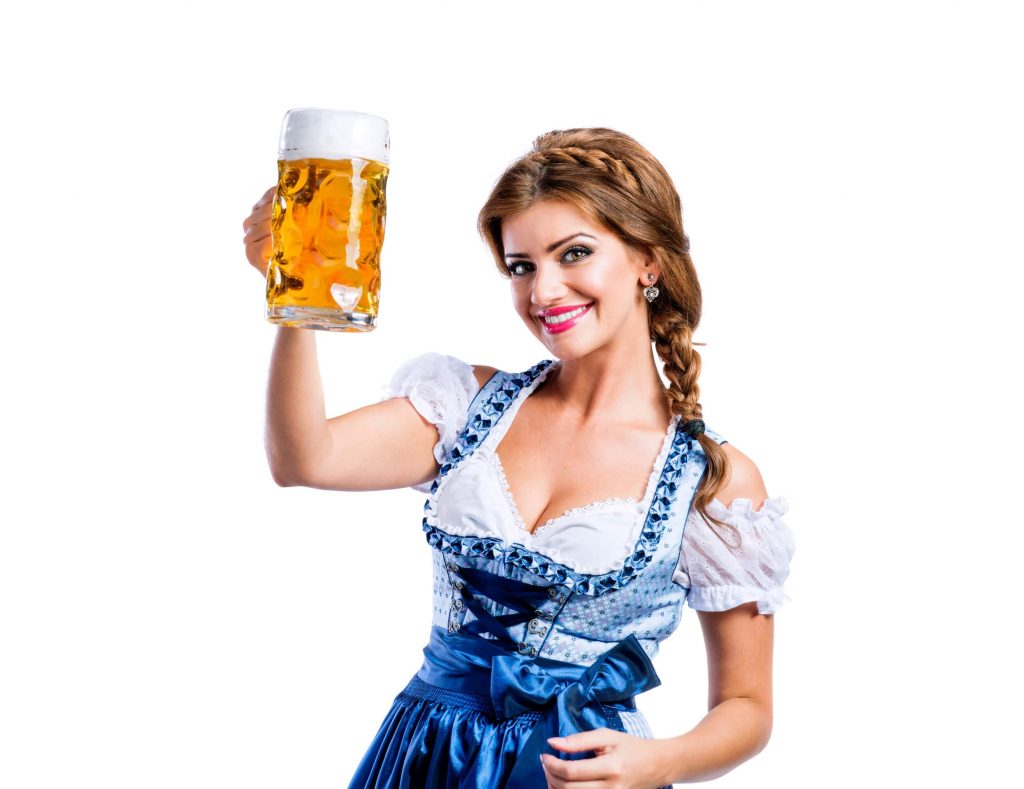
1. She’s a professional, not a costume
Outside Germany, “beer girl” or “beer wench” is often associated with fancy-dress costumes. In Bavaria, it’s a job. Oktoberfest waitresses are hired by the individual beer tents, and many come back year after year. Some have worked the same tent for decades and have loyal regulars who book their tables specifically to be served by them.
The best-known roles at big tents are highly sought after, so experience, stamina and speed count for far more than looks.
2. She carries 10 or more litre steins at once
A full Oktoberfest Maß (a one-litre glass stein) weighs roughly 2.3 kg: about 1.3 kg for the thick glass and a kilogram of beer. An experienced waitress routinely carries ten to twelve of them at a time. That’s more than 25 kg of glass and beer, carried through crowded aisles, often up and down steps.
The Guinness World Record for carrying beer steins is regularly broken at German festivals, with record-holders managing well over 25 full steins over a short distance. You can read more about the glass and ceramic mugs themselves in our guide to German beer steins.
3. There’s a technique to it
Carrying that many steins isn’t about brute strength alone. Waitresses hook their fingers through the handles and press the glasses tightly together, so the steins support each other in a compact block. A second row is often balanced on top of the first. The weight is held close to the body with straight wrists, which puts less strain on the arms.
It takes weeks of practice to master, and many first-season waitresses train at home with steins full of water.
4. She runs her own small business
At many Oktoberfest tents, waitresses operate a little like independent traders. They buy beer tokens or pay for the drinks up front, then collect the money from guests at the table. Every Maß that’s served but not paid for comes out of the waitress’s own pocket.
That’s why an Oktoberfest waitress will always ask for payment as soon as she puts the beer down, and why they carry large leather money bags on their belts.
5. Tips make up most of her income
The base wage is modest, and most of the money is made in tips. Rounding up the bill is expected in Germany, and a tip of around 10 per cent is the standard in beer tents. A hard-working waitress at a busy tent can earn several thousand euros over the festival’s two and a bit weeks, which is a major reason the jobs are so competitive.
If you’re visiting Oktoberfest, be generous with your tip. Your waitress is also more likely to find you a seat and keep your beer coming.
6. The shifts are brutal
Oktoberfest runs for 16 to 18 days, and the tents are open from morning until late at night. Waitresses typically work long shifts on almost every day of the festival, on their feet the entire time.
Many describe the experience as closer to an endurance sport than a job, and experienced waitresses swear by comfortable shoes, compression socks and plenty of water.
7. The dirndl is her uniform
The traditional dress worn by German beer girls is the dirndl, a folk costume from Bavaria and Austria. It has three main parts: a fitted bodice and skirt, a short white blouse worn underneath, and an apron tied at the waist.
Originally the everyday working clothes of rural women and servants, the dirndl was later adopted by the upper classes and is now worn proudly at festivals, weddings and celebrations across southern Germany. At Oktoberfest, each tent usually has its own dirndl design, so the staff are easy to spot.
8. The bow on her apron sends a message
This is one of the most famous pieces of dirndl trivia. Where the apron bow is tied is said to show the wearer’s relationship status:
- Tied on the left: single
- Tied on the right: married or in a relationship
- Tied at the front centre: traditionally a young girl
- Tied at the back: widowed, or working as a waitress
Waitresses tie their bows at the back for a practical reason: it keeps the bow out of the way while they’re serving. So if you’re dressing up for Oktoberfest, choose your side carefully!
9. Serving responsibly is part of the job
With one-litre steins of strong festival beer (usually around 6% ABV), keeping things safe is a big part of a waitress’s role. Tent staff can and will refuse to serve guests who’ve had too much, and security is never far away.
In Australia, anyone serving alcohol, including staff at German beer halls and Oktoberfest events, needs a Responsible Service of Alcohol (RSA) certificate. So the German beer girl you meet at an Australian Oktoberfest will have been trained to serve you responsibly, too.
10. You can meet her in Australia
You don’t have to fly to Munich to be served by a German beer girl. Oktoberfest celebrations are held across Australia every year, and a number of German restaurants and beer halls have waitresses in traditional dirndls all year round.
Take a look at our guides to German beer festivals and German beer halls, or check the city guides for Sydney, Melbourne, Brisbane, Perth and Adelaide.
How to dress like a German beer girl
Heading to an Oktoberfest party? Here’s how to get the look right:
- Choose a proper dirndl. A traditional dirndl has a knee-length or longer skirt. The very short, low-cut “beer wench” outfits sold as fancy dress are a costume-shop invention and not what you’d see in Munich.
- Add a white blouse. The short, puffed-sleeve blouse goes under the bodice.
- Tie your apron. Pick your side based on the bow code above.
- Style your hair. Braids, whether a crown braid or two plaits, are the classic choice.
- Accessorise. A heart-shaped gingerbread necklace (Lebkuchenherz), a flower hair clip or a small felt hat completes the look.
- Wear comfortable shoes. Flat shoes or low heels. You’ll be standing on benches!
For more outfit ideas, including the men’s lederhosen, see our German beer costume guide, and our page on the German beer maid.
German beer girl FAQs
What is a German beer girl called in German?
She’s called a Kellnerin (waitress) or, in Bavaria, a Bedienung. At Oktoberfest the term “Wiesn-Bedienung” is also common, as Munich locals call the festival “die Wiesn”.
How many beers can an Oktoberfest waitress carry?
Most experienced waitresses carry 10 to 12 full litre steins at once. Record attempts have seen well over 25 carried over a short distance.
What is the dress a German beer girl wears?
It’s called a dirndl: a traditional Bavarian and Austrian dress made up of a bodice, skirt, blouse and apron.
What does the dirndl bow mean?
Traditionally, a bow tied on the left means single, on the right means taken, at the front means a young girl, and at the back means widowed or a waitress.
Is “beer wench” the same as a German beer girl?
Not quite. “Beer wench” is an English term mostly used for fancy-dress costumes. The real German beer girl is a professional waitress in a traditional dirndl.